
What Does a Human Resources Business Partner (HRBP) Do?
Key Takeaways
An HR Business Partner aligns people strategy with business goals by advising leaders on workforce decisions
The role blends employee relations, talent planning, and change support, using data to guide actions
You can assess fit for the role by comparing required competencies with your current HR and business skills
You are in HR, but leadership wants strategy not admin
You close out an employee relations case, update a policy, and clean up a backlog of tickets. Then a leader pings you with a very different ask: reduce turnover on their team and raise performance, not just keep things compliant.
Many HRBPs support roughly 100–300 employees per partner, depending on company size and complexity. That range is a clue about the job: your value is less about doing every task yourself and more about picking the few people problems that move team results.
By the end of this post, you will be able to describe what sits inside HRBP scope, what the day-to-day work can look like, which skills show up most often in strong partners, and how to start preparing for the role without guessing. If you only do one thing first, do this: write down the top two business outcomes your leaders are being measured on this quarter (for example, attrition in a 40-person team or time-to-productivity for new hires) and connect your HR work to those outcomes.
You need a clear definition of the HRBP role and where it fits
Next, if your title says HRBP but your calendar looks like nonstop admin, the problem is often role blur, not effort. An HR Business Partner is the person who connects business goals to people decisions, usually for a defined client group (for example, the Sales org or a specific region), and works through others to get work done.
As a measured check, a clear HRBP role usually has a defined client group, a regular leadership cadence (often weekly or biweekly), and a visible set of outcomes tracked over a quarter, not just tasks completed per day.
That said, it helps to separate HRBP work from neighboring roles so leaders know what to expect and where to send requests:
HRBP: Advises leaders on org design, performance, engagement, workforce plans, and change; owns the relationship with the business for people topics
HR generalist: Handles a wide range of employee issues and processes day to day, especially in smaller orgs; often does more transaction work
HR manager: Usually a people manager inside HR who owns delivery for a team or function; may be operational or strategic depending on scope and level
Recruiter: Owns hiring pipelines, candidate experience, and offers for assigned roles; partners with HRBP on headcount plans and role design
HR operations: Runs the core HR services (systems, payroll coordination, data changes, workflows, policies administration); keeps processes consistent and timely
Here’s the catch: HRBP works best when the org has enough HR operations or shared services to absorb high-volume tasks. It fails when every employee question lands with the HRBP and there is no clear handoff path.
So you want the reporting line, client group, and partner map written down in plain language. Start with three definitions you can say in one sentence each:
Reporting line: Who the HRBP reports to and how priorities are set (for example, HR leader sets standards, business leader sets the agenda for the client group)
Client group: Exactly which leaders and teams the HRBP supports (for example, VP Sales plus all sales managers in EMEA, about 120 employees)
Partner relationships: Which centers of expertise (COEs) the HRBP pulls in and when (for example, comp team for pay ranges and offers, L&D for manager training, employee relations for investigations)
If you do one thing, make a simple intake rule: leader coaching and org planning stays with the HRBP; system changes and routine requests go to HR operations; hiring execution goes to recruiting; deep specialty topics route to the relevant COE.
You want to know what HRBPs actually do day to day
Next, it helps to picture the job as a mix of planned routines and urgent people issues. A strong HRBP is usually switching between leader conversations, employee cases, and longer-term people plans, sometimes all in the same morning.
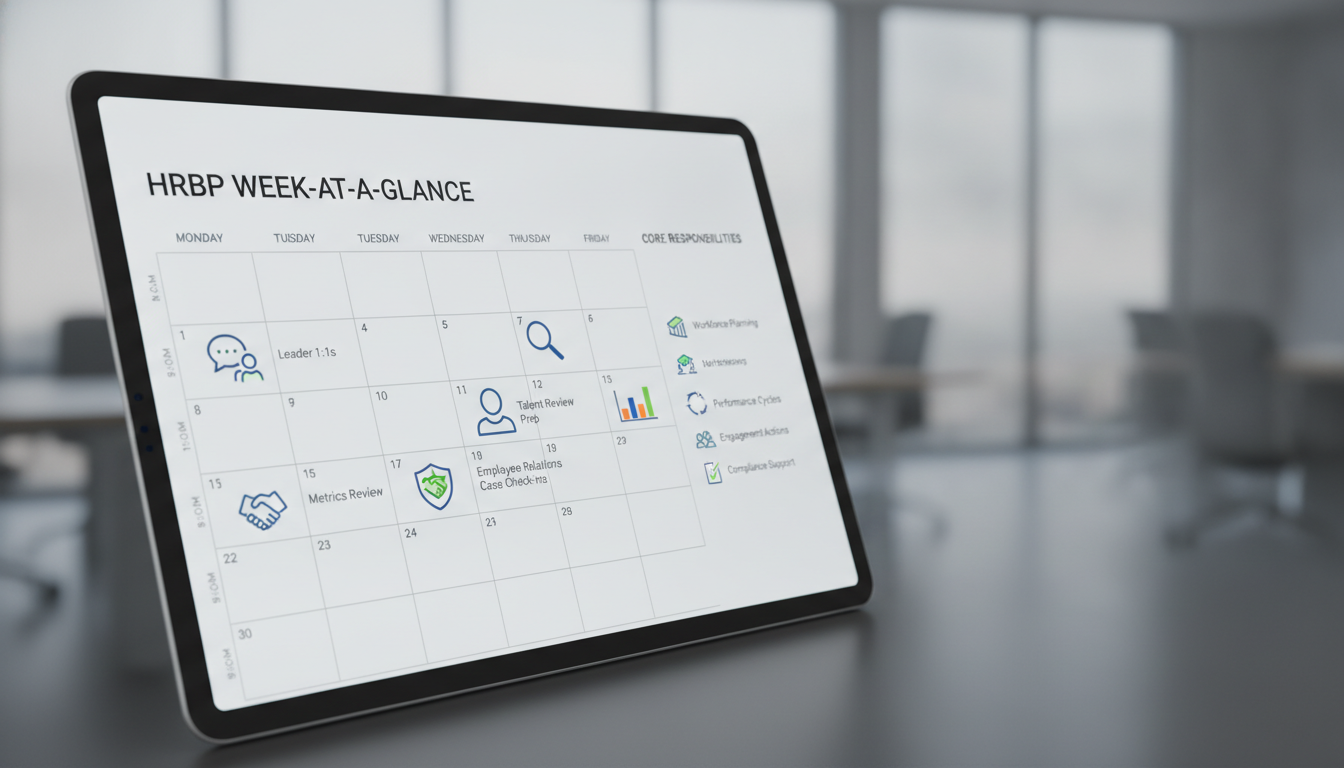
If you do one thing, ground your week in the core responsibilities HR leaders expect you to cover:
Workforce planning: headcount, skills gaps, and hiring priorities for the next 1 to 2 quarters
Talent reviews: prep for calibration meetings, succession slates, and development plans
Performance: goal setting, mid-cycle check-ins, and manager coaching before issues escalate
Employee relations: advising on conduct, conflict, attendance, and documentation steps
Engagement: turning survey signals into 2 to 3 actions a manager can actually run
Compliance support: partnering with legal or HR ops to apply policies consistently
So what does a typical week look like in practice. The rhythm is often steady, but the order changes based on what breaks first.
A realistic weekly pattern might include:
Leader 1:1s (3 to 8 per week): a 30 to 45 minute block focused on priorities, team health, and manager decisions
Case management (daily triage): 15 minutes in the morning and 15 minutes in the afternoon to track open issues and next steps
Project work (2 to 6 hours per week): performance cycle prep, org changes, onboarding updates, or manager training rollouts
Metrics reviews (weekly or biweekly): headcount, attrition, internal mobility, time-to-fill, and absence trends, then one clear “so what” per metric
Change initiatives (as needed): reorganizations, new policies, or process updates that require manager messaging and follow-through
Here’s the catch: this works best when leaders bring you in early, before decisions are final. It fails when you only get pulled in after a resignation, complaint, or messy performance situation, so you spend the week reacting instead of planning.
You want to understand the strategic levers HRBPs influence
Next, it helps to see HRBP work as a set of “levers” that change business outcomes through people decisions. The HRBP’s job is not to own every HR program, but to connect what leaders want (growth, cost control, quality, speed) to concrete choices about roles, teams, and capability.
If you do one thing, get clear on the business priority first. A hiring plan that makes sense for a growth quarter can be the wrong move in a margin crunch, and capability building works best when the work is stable enough to practice, but fails when the team is constantly reshuffled.
Translate business priorities into people plans
So when a leader says “We need to hit the number,” an HRBP turns that into a people plan that can be acted on in the next 30 to 90 days. This usually shows up in four places:
Org design: clarifying decision rights, spans of control, and which teams need to be centralized vs embedded
Hiring plans: headcount targets by role, sequencing hires, and deciding what can be contract vs full time
Capability building: picking 1 to 2 skill gaps that block results (for example, frontline coaching, account planning, quality controls) and setting a simple practice loop over 4 to 8 weeks
Succession: identifying 1 to 3 critical roles and naming ready-now and ready-soon options, plus what experience they need next
A common mistake is starting with a job description or a training catalog. The fix is to start with a constraint: budget, time, or capacity. If you’re short on time, skip broad competency models and instead map the top 5 outcomes the team must deliver, then link each outcome to one role or skill that is missing today.
Use HR analytics to spot problems early
That said, “analytics” does not mean building dashboards all day. It means reading signals and asking better questions, then testing one change at a time.
Key signals HRBPs often interpret with leaders include:
Turnover: where exits cluster (team, manager, tenure band), and whether it is regrettable loss or expected churn
Time-to-productivity: how long it takes a new hire to hit basic output, and what step in onboarding slows them down
Performance distribution: whether ratings cluster in the middle, whether standards vary by manager, and where top performance is concentrated
Engagement signals: theme patterns from surveys, stay interviews, manager 1:1 notes, and internal mobility requests
Here’s the catch: metrics without context can push the wrong decision. For example, a sales team with low engagement and high turnover might need manager coaching and clearer targets, not more perks. In practice, pair one metric with one operational view (pipeline health, quality defects, SLA misses) and agree on a small experiment you can review in 2 to 4 weeks.
You are unsure which skills and behaviors make an HRBP effective
Next, if your HR work has mostly been policies, processes, and tickets, the HRBP skill set can feel vague because it shows up in conversations, not forms. A practical way to think about it is: an effective HRBP helps leaders make better people decisions, faster, with fewer surprises later.
If you do one thing, get strong at consulting basics: clarify the real problem, confirm what success looks like in measurable terms, and offer 2 to 3 options with tradeoffs. This works best when leaders want input; it fails when you jump straight to “the answer” without asking a few focused questions first.
That said, most HRBP effectiveness comes from a small cluster of competencies you can practice in weekly meetings, 1:1s, and difficult conversations:
Consulting: diagnose before you prescribe, then summarize the decision and next steps in writing
Stakeholder management: map who must approve, who influences, and who will feel the impact, then tailor messages for each group
Coaching: use simple prompts like “What outcome do you want in 30 days?” and “What are you willing to change?”
Conflict resolution: separate facts from stories, set a clear conversation goal, and agree on one behavior to try for the next two weeks
Business acumen: tie advice to cost, time, risk, and capacity (for example, “If we hire later, delivery slips by 4 to 6 weeks”)
Data literacy: use a few reliable signals (attrition rate, time to fill, engagement pulse, absence) and ask what the data can and cannot prove
So the mindset shift is often the bigger change: moving from policy enforcement to risk-balanced advising and decision facilitation. Instead of “That’s not allowed,” you move to “Here are the risks, here are two workable paths, and here’s what I recommend based on your goal.”
Here’s the catch: new HRBPs often try to win by being the most helpful person in the room, then get pulled back into admin work. The fix is to protect time for leader-facing work (for example, two 60-minute leader blocks per week) and to close every meeting with a decision, an owner, and a date.
You need to know tools, processes, and metrics HRBPs use
Also, you do not earn trust as an HRBP just by giving good advice, you earn it by showing your work in the same tools and routines leaders already use to run the business. The goal is not more paperwork, it is shared visibility so decisions do not depend on memory or hallway conversations.
If you do one thing, build a repeatable monthly rhythm: pull a short set of people signals, review what changed, write down decisions, and track follow-ups. This is the difference between being seen as “support” and being seen as a partner who runs a tight operating cadence.
Here are common systems and artifacts you will use in real HRBP work:
HRIS dashboards (your system-of-record reports) for headcount, turnover, hiring flow, and absence patterns by team or manager
Talent review grids (often a 9-box) to compare performance and growth potential during calibration
Role profiles that spell out outcomes, scope, and required skills so hiring and performance talks stay consistent
Decision logs to capture what was decided, when, and why, especially after reorganizations, offers, or policy exceptions
Action plans that list owners, dates, and success measures for themes like retention risk, manager gaps, or team health
Common mistake: exporting a big report and forwarding it to leaders. Fix: bring a 10-minute readout with 2 to 3 patterns, one likely cause, and a specific next step you are asking the leader to take.
Next, metrics matter most when they answer a decision the business actually has to make this quarter. Practical KPIs HRBPs track and discuss include:
Attrition (overall and regrettable) by team, tenure band, or manager, then compare month-over-month
Internal mobility such as transfers and promotions, plus how long it takes to fill roles internally versus externally
Leader effectiveness signals like engagement themes, manager feedback trends, or completion and outcomes of manager actions
Performance outcomes including distribution shifts after calibration and how many goals were met in critical roles
Employee relations (ER) case trends such as case volume, repeat topics, time to close, and hotspots by function
Here is the catch: a KPI without context can trigger the wrong fix. Attrition going up can mean low pay, unclear roles, a manager issue, or a planned business change, so pair the metric with one confirming input such as exit themes, stay interviews, or workload signals.
In practice, you will spend 30 to 60 minutes before a monthly business review pulling these numbers and writing a short narrative. If you are short on time, skip building new dashboards and write a one-page update that includes:
What changed (2 to 3 metrics)
Why it likely changed (one hypothesis)
What you recommend doing next (one action with an owner and date)
What you will measure next month to see if it worked
You want a realistic roadmap to become an HRBP
Next, focus less on the title and more on the proof that you can support a business leader through real decisions. HRBP roles usually go to people who have shown they can advise managers, run core people cycles, and lead change without needing hand-holding.
Most paths into HRBP work fall into three buckets:
Generalist to HRBP: best if you already support a group of managers and want broader scope; it can fail if your role is mostly tickets and paperwork with no manager-facing time
Specialist to HRBP (recruiting, L&D, comp, HRIS): works best when you can translate your specialty into tradeoffs the business cares about (time-to-fill, ramp time, pay ranges, retention); it can fail if you stay seen as a back-office expert only
Operations to HRBP (people ops, payroll, workforce ops, or even non-HR ops): works best when you have steady business exposure and can speak in terms of headcount, service levels, and cost; it can fail when you cannot show manager advising or employee relations judgment
If you do one thing, build a portfolio of experiences that proves you can partner with leaders. Use this checklist to spot gaps and pick the next assignment to pursue:
Lead a change project: for example, roll out a new schedule policy across a 200-person site over 6–8 weeks, track adoption, and handle pushback
Advise managers: for example, coach a new people manager on performance expectations and how to document weekly 1:1s for 30 days
Handle ER cases (employee relations): for example, support a conduct investigation with clear notes, timelines, and outcomes that match policy
Run talent cycles: for example, coordinate performance reviews for a 60-person department, calibrate ratings with leaders, and follow through on development plans
If you're short on time, skip trying to master every HR specialty at once and pick one high-visibility business problem to own. A simple way to start is to ask for a stretch assignment that touches a real leader pain point, then measure the result in something concrete like manager time saved, fewer escalations, or cycle time from start to finish.
Closing remarks
So, keep this line in mind as you shift from service work to true partnership: “Strategy succeeds or fails through people.”
An HRBP approach works best when the business problem is messy and cross-functional, like slow hiring in one function, uneven manager quality, avoidable turnover in a key role, or teams that miss deadlines because priorities keep changing. But it fails when you try to solve a people problem without a clear business outcome, owner, and timeframe.
Next, pick one people problem in your organization that would benefit most from an HRBP approach, then decide your first move this week.
Choose a single problem with a measurable impact (time, cost, quality, retention)
Name one business owner and one HR owner
Write a one-sentence outcome (for example: reduce ramp time for new hires in Sales over the next 90 days)
If you are short on time, start with a 30-minute listening block with 2 managers and 2 employees, then summarize themes and one proposed next step
Common mistake: starting with a program
Fix: start with the decision the business needs to make, then bring people data and options
FAQ
What is the difference between an HRBP and an HR generalist
Is an HRBP role more strategic or operational
What qualifications do you need to become an HRBP
How do HRBPs measure impact
Director Development
Courses
-
Boardroom Excellence
-
Corporate Accountability
-
Financial Acumen
-
Digital Transformation
-
Director’s Toolkit
-
Global Business Strategies
-
Legal Insights for Directors
-
Managing Crisis
-
Mergers and Acquisitions
-
Risk Management Strategies
-
Stakeholder Engagement
-
Sustainability and ESG
-
The Modern Director
Executive Education
Categories
-
Advanced People and Culture
-
Corporate Governance Ethics
-
Customer-Centric Strategies
-
Digital Transformation
-
Financial Acumen for Leaders
-
Global Business Strategy
-
Innovation and Change
-
Sales and Marketing
-
Strategic Leadership and Vision
-
Sustainability and CSR
Executive Education
Courses
-
Accountability Transparency
-
Advanced CRM and AI
-
Advanced Financial Strategy
-
Advanced Strategic Planning
-
Blockchain and Emerging Tech
-
Boardroom Dynamics
-
Brand Leadership
-
Building Data-Driven Sales
-
Building Executive Resilience
-
Corporate Gov Excellence
-
Corporate Social Responsibility
-
Cross-Border Mergers
-
Cybersecurity Strategy
-
Data-Driven Decision Making
-
Design Thinking for Executives
-
Developing Global Expansion
-
Driving Growth
-
Driving Service Excellence
Executive Education
Courses
-
Advanced Communication
-
Business Continuity
-
Diversity and Inclusion
-
Service Excellence
-
Data-Driven Decisions
-
Corporate Social Responsibility
-
Planning and Budgeting
-
Design Thinking
-
Product Development
-
Visionary Leadership
-
Corporate Governance
-
Process
-
Performance
-
Risk
-
Sales Strategy
-
Environmental Impact
-
Emerging Technologies
-
Work Life Balance
-
View More
Management
Categories
-
Communication
-
Crisis and Risk
-
Cultural Competency
-
Customer-Centric
-
Digital Transformation
-
Ethical and Sustainable
-
Financial
-
Innovation Change
-
Innovation Entrepreneurship
-
Leadership and Strategic
-
Legal and Compliance
-
Operational
-
People
-
Project
-
Sales and Marketing
-
Sustainability and Enviro
-
Technology and Cybersecurity
-
Time and Stress
Management Courses
-
Coming Soon
Diploma Courses
-
Coming Soon
Industry Qualification Categories
-
Coming Soon
Industry Qualification Courses
-
Coming Soon
Trade & Vocational
Categories
-
Business & Finance
-
Creative Arts & Design
-
Education & Training
-
Environ & Agri Tech
-
Fashion & Textile
-
Healthcare & Medical
-
Hospitality & Service
-
Law & Security
-
Manufacturing & Engineering
-
Miscellaneous
-
Personal Dev & Wellness
-
Technology and IT
-
Trades and Construction
-
Transport & Logistics
Trade & Vocational
Courses
-
3D Game Development
-
3D Modeling and Animation
-
3D Printing and Additive
-
Aerospace Technician
-
Air Conditioning Repair
-
Aircraft Avionics Systems
-
Aircraft Maintenance
-
App Development
-
Apparel Manufacturing
-
Auto Body Repair
-
Automated Systems Technician
-
Automotive Repair
-
Baking and Pastry Arts
-
Barista and Coffee Brewing
-
Bicycle Repair
-
Biomedical Equipment
-
Biotechnology Laboratory
-
Blockchain Development
Trade & Vocational Courses
-
Broadcasting and Journalism
-
Building Maintenance
-
Business Intelligence and Data
-
Business Process Outsourcing
-
Computer Numerical Control
-
Carpentry and Woodworking
-
Child Care and Early Education
-
Cloud Computing
-
Commercial Driver’s License
-
Commercial Photography
-
Commercial Refrigeration
-
Computer Programming
-
Construction Project
-
Corporate Training
-
Cosmetology and Skincare
-
Culinary Arts and Cuisine
-
Cybersecurity Fundamentals
-
Cybersecurity Risk
-
Cybersecurity Law Enforce
Trade & Vocational Courses
-
Data Analysis Visualization
-
Data Science Machine Learning
-
Database Administration
-
Dental Assistant and Hygiene
-
Digital Forensics
-
Digital Illustration Concept Art
-
Digital Marketing SEO
-
Digital Photography Editing
-
Drone Maintenance
-
E-commerce Development
-
Educational Technology
-
Elderly Care Geriatric
-
Electrical Installation
-
Electrocardiogram Technician
-
Electronics Repair
-
Emergency Medical Technician
-
Environmental Health Safety
-
Event Planning
-
Event Videography
Trade & Vocational Courses
-
Fashion Design Tailoring
-
Fashion Merchandising
-
Film Production
-
Fire Safety Prevention
-
Firefighting Response
-
Fitness Trainer Coaching
-
Food Safety Sanitation
-
Forklift Operation
-
Furniture Restoration
-
Game Design (UX)
-
Geographic Info Systems
-
Graphic Design Com
-
HVAC Technician
-
Heavy Equipment
-
Home Inspection Codes
-
Hospitality Service
-
Hotel Front Desk
-
Human Resources Dev
-
Human Resources Manage
Trade & Vocational
Courses
-
IT Network Security
-
IT Support Technician
-
Industrial Technician
-
Industrial Machine Operations
-
Interior Design Planning
-
Interior Lighting Design
-
Landscape Architecture Design
-
Landscape Irrigation Systems
-
Law Enforce Criminal Justice
-
Leadership Skills Training
-
Luxury Goods Sales Marketing
-
Machine Learning for Business
-
Marine Biology Technician
-
Masonry and Concrete Work
-
Massage Therapy Bodywork
-
Medical Laboratory Technician
-
Mobile App Development
-
Music Production Composition
-
Network Cable Installation
-
Nursing Assistant Training
-
Painting Decorating
Trade & Vocational Courses
-
Personal Assistant Support
-
Personal Development
-
Personal Financial Planning
-
Pharmacy Technician
-
Physical Therapy Assistant
-
Piping and Pipeline Systems
-
Plastering Drywall Installation
-
Plumbing Systems
-
Precision Agriculture Farming
-
Precision Machining
-
Project Estimating and Costing
-
Property Management
-
Public Health and Wellness
-
Public Relations Com
-
Public Safety Management
-
Quality Assurance Control
-
Renewable Energy Systems
-
Risk Management Compliance
-
Robotics Welding
-
Robotics Automation Systems
-
Roofing Waterproofing
Trade & Vocational Courses
-
Sculpture Fine Art Techniques
-
Security Systems Installation
-
Sewing Garment Construction
-
Smart Automation Systems
-
Smart Grid Renewable Energy
-
Smart Home Technology
-
Social Media Management
-
Solar Panel Installation
-
Sound Engineering Mixing
-
Sports Coaching
-
Sports and Fitness Nutrition
-
Structural Engineering Drafting
-
Supply Chain Logistics
-
Sustainable Construction
-
Tattoo Art and Body Piercing
-
Technical Writing Documents
-
Telecommunications Networking
-
Textile and Fabric Technology
-
Travel Agency Operations
-
Travel Tourism Management
-
Urban Farming Aquaponics
Trade & Vocational
Categories
-
Business & Finance
-
Creative Arts & Design
-
Education & Training
-
Environ & Agri Tech
-
Fashion & Textile
-
Healthcare & Medical
-
Hospitality & Service
-
Law & Security
-
Manufacturing & Engineering
-
Miscellaneous
-
Personal Dev & Wellness
-
Technology and IT
-
Trades and Construction
-
Transport & Logistics
Career Pathways
-
Accountant
-
Computer Programmer
-
Data Scientist
-
Teacher
-
Engineer
-
HSE Officer
-
Hotel Manager
-
Human Resource Manager
-
Info Tech Manager
-
Lawyer
-
Executive Officer
-
Marketing Manager
-
Nurse
Career Pathways
-
Coming Soon
Career Pathways
-
Coming Soon
Career Levels
-
Director Development
-
Executive Education
-
Management
-
Diploma
-
Industry Qualifications
-
Trade & Vocational
-
Career Pathways
-
Soft Skills
-
Free Online Courses
Course Disciplines
-
Accounting & Finance
-
Agriculture & Environment
-
Aviation & Transportation
-
Communication & PR
-
Computer Science
-
Creative Arts & Media
-
Data Science
-
Education & Teaching
-
Emerging Technology
-
Engineering
-
Health Safety & Environment
-
Health & Wellness
-
Hospitality
-
Human Resources
-
Information Technology
-
Languages
-
Legal & Regulatory
-
Marketing & Sales
-
Medical
-
Performing Arts & Theatre
-
Security
-
Social Sciences
-
Sports
Soft Skills
-
Business Management
-
Coding and Software
-
Creative Design Pro
-
Digital Marketing
-
Entrepreneurship and Start-up
-
Financial Management
-
Hotel Management
-
IT and Cybersecurity
-
Microsoft Office
-
Project Management
-
Soft Skills
Partners
-
Learning Centres
-
Academic Partners
-
Corporate Partners
-
NGO Partners
-
Professional Associations
-
AION for Business
Regions
-
Africa
-
Asia
-
Caribbean
-
Central America
-
Europe
-
Middle East
-
North America
-
Oceania
-
South America
Our Vision is to Deliver Global Affordable Quality Education and to Solve the United Nations Sustainable Development Goal #4
Our Mission is to Empower Individuals with the Skills they need to Follow any Career Path they seek.
Our Strategy entails a Flexible Education Model, Practical Skills & Global Qualifications, Our Students are Positioned for Jobs, Entrepreneurship, Career Changes & Competence in the Real World.
AION Academy
-
Home
-
About
-
Blog
-
News
-
Work With Us
-
Affiliate Programme
-
Full Course List
Connect
-
Contact Us
-
Sign In
-
Sign Up
-
Reset Password
-
Idea Hub
-
Create Your Course
-
Merchandise Store
-
Media Kit
-
Web Links
Legal
-
Terms of Service
-
Privacy Policy
-
Cookie Policy
-
Honour Code
-
Accessibility Policy
-
Trademark Policy
-
Modern Slavery Statement
-
Your Privacy Choices
-
Sitemap