25 Essential Human Resource Skills Every HR Professional Needs in 2026
Key Takeaways
HR in 2026 is not just about being great with people. You also need enough data fluency to read signals (like trend changes in attrition), enough AI judgment to spot bad inputs or biased outputs, and strong ethics to know where the line is when decisions affect livelihoods.
The HR pros who stand out translate business goals into talent outcomes you can track. For example: turning a “grow revenue” goal into shorter time-to-productivity for new hires, fewer missed shifts on the frontline, or higher internal fill rates for hard-to-staff roles.
A practical skills roadmap keeps you from trying to learn everything at once. If you do one thing, choose 2 to 3 skills that connect to a real metric you can influence in 30 to 60 days, then document a before-and-after so your impact is easy to see.
Key takeaways:
Combine people leadership with data fluency, AI judgment, and strong ethics
Translate business goals into measurable talent outcomes and better employee experience
Use a skills roadmap to prioritize what to learn next and prove impact faster
When HR is expected to do more with less
Next, picture Q1 planning: hiring targets go up, budgets get tighter, and leaders ask HR to “prove ROI” in a few weeks. You are expected to fill roles, reduce turnover, fix manager behavior, and keep engagement steady, often with fewer recruiters and less tooling than last year.
The fastest way out of the scramble is to separate what you do into repeatable work and one-time work. Repeatable work is onboarding, offer process, interview training, weekly headcount reporting. One-time work is a reorg, a new HRIS rollout, or a compensation reset. If you do one thing first, make the repeatable work consistent, because that is where small changes save hours every week.
Also, leaders usually trust what they can see and compare. As a practical benchmark, teams that track a few core people metrics can cut time-to-hire by 10–20%, because bottlenecks show up quickly (for example, interviews waiting 7 days for feedback, or offers taking 5 days to approve).
A common mistake is tracking too many metrics and updating them manually. The fix is to pick 3–5 measures you can refresh weekly in under 30 minutes, such as:
Time-to-hire (by role family)
Offer acceptance rate
New hire 30/60/90-day retention
Hiring manager response time
Candidate drop-off stage
By the end of the next sections, you will have a categorized list of 25 HR skills and a simple plan to assess where your team has gaps, so you can decide what to train, what to standardize, and what to stop doing.
Build business credibility and strategic influence
Next, credibility in HR often comes down to one thing: can you connect people work to business outcomes. When you talk about talent priorities in the same language leaders use for revenue, risk, and productivity, you stop sounding like a service desk and start sounding like a growth function.
If you do one thing, do this: translate every major people initiative into a short business case. Include the impact, the cost, the tradeoff, and the decision you need (for example, headcount approval in Q2, or manager time for training). This works best when you have a clear baseline metric; it fails when you only bring opinions and no options.
Position HR as a growth function
Also, business acumen is not about knowing every KPI. It is about understanding what creates value in your company’s value chain, then tying talent decisions to the bottlenecks. For example, in a sales-led company, time-to-ramp and front-line manager quality may matter more than polishing a benefits guide.
A practical checklist for credibility in leadership meetings:
Name the business goal first (retain customers, ship faster, reduce defects)
Show the constraint (budget, hiring market, manager capacity, timeline)
Offer 2 to 3 options with tradeoffs
Recommend one option and say what you need from stakeholders
Common mistake: presenting a long list of HR activities. Fix it by presenting a prioritized plan with a clear “now, next, later” sequence and one measurable outcome per item.
Lead with stakeholder management when priorities conflict
That said, strategic influence is mostly stakeholder management when leaders disagree. You build trust by making conflicts visible early, clarifying who decides, and keeping people informed even when they do not get what they asked for.
In practice, use a simple meeting script when two teams want the same limited resource (for example, one recruiter, one HRBP, or a $40k learning budget):
Confirm the shared goal in one sentence
State what is constrained (time, money, headcount)
Ask each leader for what they will stop doing if their request is approved
Propose a decision rule (risk reduction first, revenue impact second, timing third)
Close with a clear owner and next check-in date
If you’re short on time, skip the perfect slide deck and write a 6 to 8 sentence update: what you heard, what you recommend, what will happen next, and what you need from each stakeholder.
Category 1: Business and strategy skills
So, focus on the skills that let you plan and trade resources like a business partner, not just an HR specialist:
Business acumen and value-chain understanding: know where work turns into revenue or risk
Workforce planning and scenario modeling: compare “freeze hiring,” “hire 5 now,” and “contractor bridge” over 90 days
Organizational design and role clarity: reduce duplicate ownership by defining decision rights
Budgeting and resource prioritization: choose what to fund this quarter and what to pause
Executive communication and influence: deliver a 2-minute summary with one recommendation and one ask
Before/after example: instead of saying “We need leadership training,” say “Manager attrition is delaying onboarding by 2 weeks; a 4-session manager coaching sprint for 15 managers targets ramp time and rework.”
Category 2: Leadership and change skills
Here’s why change and leadership skills matter: even the right plan fails if managers do not adopt it. These skills help you move from policy creation to behavior change.
Change management and change storytelling: explain what changes, why now, and what stays the same
Coaching managers to raise team performance: run 30-minute manager clinics on expectations and feedback
Conflict resolution and difficult conversations: handle performance, pay, and team tension without delays
Cross-functional collaboration and alignment: align HR, Finance, Legal, and Ops on one operating plan
Decision-making under ambiguity: make a call with 70% of the data and set a review point
Tradeoff to remember: fast change works best when scope is small (one team, one region) and support is strong; it fails when you roll out company-wide changes without manager time, clear role ownership, or a feedback loop.
Deliver high-trust people operations at scale
Next, the fastest way to lose trust is to ask managers to follow a process that feels hard, slow, or unclear. High-trust people operations at scale means the basics work the same way for everyone, even when the HR team is small and the headcount keeps growing.
If you only do one thing, reduce handoffs. Each extra approval step adds waiting time and creates “HR said no” moments that managers do not understand. Aim for fewer steps, clear owners, and policies written in plain language that a new manager can apply in 5 minutes.
Design processes employees actually follow
So, design around real behavior, not ideal behavior. A good process is one people can complete between meetings, with the minimum required fields and a predictable timeline.
Common mistakes and fixes:
Mistake: policies that explain the why but not the do
Fix: add a short “What to do” section with 3 steps and one example
Mistake: too many exceptions that require HR to interpret every case
Fix: define 2 to 3 standard scenarios and when to escalate
Mistake: unclear handoffs between manager, HR, and finance
Fix: assign one owner per step and publish turnaround times (for example, 2 business days)
Tradeoff to plan for: standardization works best when roles are similar and growth is steady. It can fail when teams have very different job types or high turnover, so keep a small “exception path” with tight documentation.
Make employee experience measurable
That said, you cannot improve employee experience if you only hear about problems when someone quits. Make friction visible in three places that affect almost everyone: hiring, onboarding, and performance cycles.
A simple measurement set you can start in a week:
Hiring: time from application review to first interview, and passing rates per stage
Onboarding: time to first shipped task, first customer interaction, or first closed ticket (pick one based on role)
Performance cycles: on-time completion rates for manager reviews and calibration meetings
Constraint: if you are short on time, skip a big survey. Start with one metric per stage plus a short “What slowed you down” question after onboarding week 2.
Category 3: People operations and employee experience skills
In practice, these skills help you make day-to-day work feel fair and consistent while keeping the load manageable for managers.
Focus areas to build:
Hiring process design and structured interviewing
Use a scorecard with 4 to 6 criteria and a 1 to 5 scale
Onboarding design and time-to-productivity focus
Create a 30-60-90 plan template and role-based checklists
Compensation fundamentals and job leveling literacy
Write job levels in plain language and tie them to scope and impact
Benefits communication and employee support
Publish a one-page guide for common scenarios (new hire, life event, leave)
Performance management systems and calibration
Define definitions for ratings and run a short calibration meeting agenda
Before/after example: before, interviewers “vibe check” and notes vary by person. After, every interviewer answers the same 2 questions per competency and submits scores within 24 hours.
Category 4: Employee relations and compliance skills
Also, trust breaks quickly when similar situations get different outcomes. Employee relations and compliance skills help you act consistently, document decisions, and reduce risk without turning every issue into a legal event.
Core skills to practice:
Labor law basics and policy interpretation
Know what your policy says, what it does not say, and when to escalate
Investigations and documentation discipline
Stick to timelines, objective notes, and a clear allegation-to-fact trail
Coaching on conduct and workplace standards
Give managers scripts for a first conversation and a follow-up plan
Risk management and crisis response readiness
Keep a ready checklist for urgent cases (harassment, threats, media attention)
Ethical reasoning and consistent decision standards
Use the same questions each time: intent, impact, pattern, and precedent
Here’s the catch: going fast without documentation feels kind until it backfires. Going heavy on process feels “safe” until it slows everything down. The middle ground is a simple, repeatable workflow that records the essential facts and decisions every time.
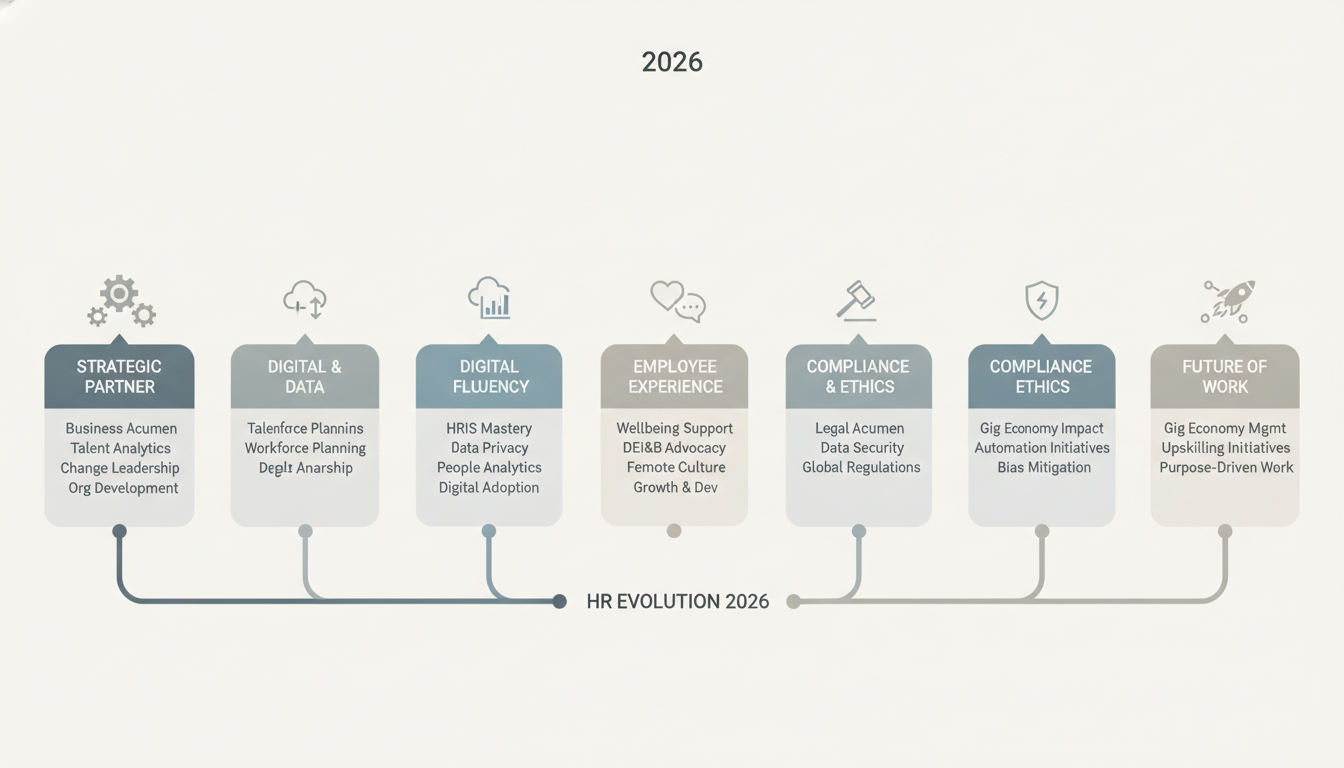
Use data and AI to make better people decisions
Next, shift your analytics work from describing what happened to deciding what to do next. A dashboard that updates weekly is useful, but it only matters if it changes a manager’s next 1:1, a hiring plan, or a workload decision.
If you do one thing, choose metrics that trigger a clear action. For example, track offer acceptance rate by role family (so recruiting can fix compensation ranges or interview delays) and time-to-productivity in the first 30 to 60 days (so managers change onboarding and training). A common mistake is measuring what is easiest to pull from the HRIS instead of what someone can act on in the next two weeks.
Category 5: Data, analytics, and AI skills
So the goal is not “more data”, it is better judgment with better inputs. These skills help you pick the right questions, tell a clear story to leaders, and use AI where it saves time without creating new risk.
HR analytics literacy and metric selection: tie each metric to an owner, a decision, and a review cadence (weekly, monthly, quarterly)
Data storytelling for non-technical leaders: use one chart, one takeaway, and one recommended action (example: “attrition is up in Support, so we test schedule changes for 4 weeks”)
Survey design and listening strategy: keep surveys short (often 8 to 12 questions), mix pulse checks with targeted follow-ups, and close the loop within 2 to 3 weeks
AI prompting and workflow automation judgment: use AI for drafts and summaries (job posts, policy rewrites, interview notes), but keep final decisions with a named human owner
Privacy, security, and responsible AI governance: set rules for what data can be used, where it can be stored, who can access it, and how outputs are reviewed for bias
Here's the catch: AI can scale inconsistency if your inputs are messy. Works best when you have clean definitions (what counts as a “regrettable exit”), stable processes, and a review step; it fails when you use sensitive data casually, accept outputs without checking, or treat AI recommendations as neutral facts.
Closing remarks
Next, remember this when you plan your growth: what gets measured gets improved, but what gets trusted gets adopted. If you want your work to land with leaders and employees, aim for changes that are visible, repeatable, and easy to explain.
So ask yourself one practical question: which two skill categories will create the biggest impact in your current role over the next 90 days. For example, an HR generalist might pair employee relations with clear communication, while an HRBP might pair business partnering with basic analytics.
That said, progress is easier when you narrow the target. Choose one gap, set a simple practice plan, and track one metric to prove progress:
Pick one skill gap you can practice 15 minutes a day or 2 hours a week
Write one behavior you will repeat (for example, summarize meeting decisions in 5 bullet points)
Choose one metric you can track weekly (for example, hiring manager satisfaction, time to respond to employee questions, or offer acceptance rate)
Review results every Friday for 10 minutes and change one thing if the metric is flat
If you do one thing, do this: make the metric easy to collect and share. A perfect plan that never gets tracked fails, but a simple plan you can repeat for 12 weeks usually shows real movement.
Choose one HR skill outcome to improve this quarter
FAQ
How do I choose which HR skill to develop first?
What HR skills are most affected by AI in 2026?
How can I prove the ROI of HR work without advanced analytics tools?
Are these skills relevant for both HR generalists and HR specialists?
Director Development
Courses
-
Boardroom Excellence
-
Corporate Accountability
-
Financial Acumen
-
Digital Transformation
-
Director’s Toolkit
-
Global Business Strategies
-
Legal Insights for Directors
-
Managing Crisis
-
Mergers and Acquisitions
-
Risk Management Strategies
-
Stakeholder Engagement
-
Sustainability and ESG
-
The Modern Director
Executive Education
Categories
-
Advanced People and Culture
-
Corporate Governance Ethics
-
Customer-Centric Strategies
-
Digital Transformation
-
Financial Acumen for Leaders
-
Global Business Strategy
-
Innovation and Change
-
Sales and Marketing
-
Strategic Leadership and Vision
-
Sustainability and CSR
Executive Education
Courses
-
Accountability Transparency
-
Advanced CRM and AI
-
Advanced Financial Strategy
-
Advanced Strategic Planning
-
Blockchain and Emerging Tech
-
Boardroom Dynamics
-
Brand Leadership
-
Building Data-Driven Sales
-
Building Executive Resilience
-
Corporate Gov Excellence
-
Corporate Social Responsibility
-
Cross-Border Mergers
-
Cybersecurity Strategy
-
Data-Driven Decision Making
-
Design Thinking for Executives
-
Developing Global Expansion
-
Driving Growth
-
Driving Service Excellence
Executive Education
Courses
-
Advanced Communication
-
Business Continuity
-
Diversity and Inclusion
-
Service Excellence
-
Data-Driven Decisions
-
Corporate Social Responsibility
-
Planning and Budgeting
-
Design Thinking
-
Product Development
-
Visionary Leadership
-
Corporate Governance
-
Process
-
Performance
-
Risk
-
Sales Strategy
-
Environmental Impact
-
Emerging Technologies
-
Work Life Balance
-
View More
Management
Categories
-
Communication
-
Crisis and Risk
-
Cultural Competency
-
Customer-Centric
-
Digital Transformation
-
Ethical and Sustainable
-
Financial
-
Innovation Change
-
Innovation Entrepreneurship
-
Leadership and Strategic
-
Legal and Compliance
-
Operational
-
People
-
Project
-
Sales and Marketing
-
Sustainability and Enviro
-
Technology and Cybersecurity
-
Time and Stress
Management Courses
-
Coming Soon
Diploma Courses
-
Coming Soon
Industry Qualification Categories
-
Coming Soon
Industry Qualification Courses
-
Coming Soon
Trade & Vocational
Categories
-
Business & Finance
-
Creative Arts & Design
-
Education & Training
-
Environ & Agri Tech
-
Fashion & Textile
-
Healthcare & Medical
-
Hospitality & Service
-
Law & Security
-
Manufacturing & Engineering
-
Miscellaneous
-
Personal Dev & Wellness
-
Technology and IT
-
Trades and Construction
-
Transport & Logistics
Trade & Vocational
Courses
-
3D Game Development
-
3D Modeling and Animation
-
3D Printing and Additive
-
Aerospace Technician
-
Air Conditioning Repair
-
Aircraft Avionics Systems
-
Aircraft Maintenance
-
App Development
-
Apparel Manufacturing
-
Auto Body Repair
-
Automated Systems Technician
-
Automotive Repair
-
Baking and Pastry Arts
-
Barista and Coffee Brewing
-
Bicycle Repair
-
Biomedical Equipment
-
Biotechnology Laboratory
-
Blockchain Development
Trade & Vocational Courses
-
Broadcasting and Journalism
-
Building Maintenance
-
Business Intelligence and Data
-
Business Process Outsourcing
-
Computer Numerical Control
-
Carpentry and Woodworking
-
Child Care and Early Education
-
Cloud Computing
-
Commercial Driver’s License
-
Commercial Photography
-
Commercial Refrigeration
-
Computer Programming
-
Construction Project
-
Corporate Training
-
Cosmetology and Skincare
-
Culinary Arts and Cuisine
-
Cybersecurity Fundamentals
-
Cybersecurity Risk
-
Cybersecurity Law Enforce
Trade & Vocational Courses
-
Data Analysis Visualization
-
Data Science Machine Learning
-
Database Administration
-
Dental Assistant and Hygiene
-
Digital Forensics
-
Digital Illustration Concept Art
-
Digital Marketing SEO
-
Digital Photography Editing
-
Drone Maintenance
-
E-commerce Development
-
Educational Technology
-
Elderly Care Geriatric
-
Electrical Installation
-
Electrocardiogram Technician
-
Electronics Repair
-
Emergency Medical Technician
-
Environmental Health Safety
-
Event Planning
-
Event Videography
Trade & Vocational Courses
-
Fashion Design Tailoring
-
Fashion Merchandising
-
Film Production
-
Fire Safety Prevention
-
Firefighting Response
-
Fitness Trainer Coaching
-
Food Safety Sanitation
-
Forklift Operation
-
Furniture Restoration
-
Game Design (UX)
-
Geographic Info Systems
-
Graphic Design Com
-
HVAC Technician
-
Heavy Equipment
-
Home Inspection Codes
-
Hospitality Service
-
Hotel Front Desk
-
Human Resources Dev
-
Human Resources Manage
Trade & Vocational
Courses
-
IT Network Security
-
IT Support Technician
-
Industrial Technician
-
Industrial Machine Operations
-
Interior Design Planning
-
Interior Lighting Design
-
Landscape Architecture Design
-
Landscape Irrigation Systems
-
Law Enforce Criminal Justice
-
Leadership Skills Training
-
Luxury Goods Sales Marketing
-
Machine Learning for Business
-
Marine Biology Technician
-
Masonry and Concrete Work
-
Massage Therapy Bodywork
-
Medical Laboratory Technician
-
Mobile App Development
-
Music Production Composition
-
Network Cable Installation
-
Nursing Assistant Training
-
Painting Decorating
Trade & Vocational Courses
-
Personal Assistant Support
-
Personal Development
-
Personal Financial Planning
-
Pharmacy Technician
-
Physical Therapy Assistant
-
Piping and Pipeline Systems
-
Plastering Drywall Installation
-
Plumbing Systems
-
Precision Agriculture Farming
-
Precision Machining
-
Project Estimating and Costing
-
Property Management
-
Public Health and Wellness
-
Public Relations Com
-
Public Safety Management
-
Quality Assurance Control
-
Renewable Energy Systems
-
Risk Management Compliance
-
Robotics Welding
-
Robotics Automation Systems
-
Roofing Waterproofing
Trade & Vocational Courses
-
Sculpture Fine Art Techniques
-
Security Systems Installation
-
Sewing Garment Construction
-
Smart Automation Systems
-
Smart Grid Renewable Energy
-
Smart Home Technology
-
Social Media Management
-
Solar Panel Installation
-
Sound Engineering Mixing
-
Sports Coaching
-
Sports and Fitness Nutrition
-
Structural Engineering Drafting
-
Supply Chain Logistics
-
Sustainable Construction
-
Tattoo Art and Body Piercing
-
Technical Writing Documents
-
Telecommunications Networking
-
Textile and Fabric Technology
-
Travel Agency Operations
-
Travel Tourism Management
-
Urban Farming Aquaponics
Trade & Vocational
Categories
-
Business & Finance
-
Creative Arts & Design
-
Education & Training
-
Environ & Agri Tech
-
Fashion & Textile
-
Healthcare & Medical
-
Hospitality & Service
-
Law & Security
-
Manufacturing & Engineering
-
Miscellaneous
-
Personal Dev & Wellness
-
Technology and IT
-
Trades and Construction
-
Transport & Logistics
Career Pathways
-
Accountant
-
Computer Programmer
-
Data Scientist
-
Teacher
-
Engineer
-
HSE Officer
-
Hotel Manager
-
Human Resource Manager
-
Info Tech Manager
-
Lawyer
-
Executive Officer
-
Marketing Manager
-
Nurse
Career Pathways
-
Coming Soon
Career Pathways
-
Coming Soon
Career Levels
-
Director Development
-
Executive Education
-
Management
-
Diploma
-
Industry Qualifications
-
Trade & Vocational
-
Career Pathways
-
Soft Skills
-
Free Online Courses
Course Disciplines
-
Accounting & Finance
-
Agriculture & Environment
-
Aviation & Transportation
-
Communication & PR
-
Computer Science
-
Creative Arts & Media
-
Data Science
-
Education & Teaching
-
Emerging Technology
-
Engineering
-
Health Safety & Environment
-
Health & Wellness
-
Hospitality
-
Human Resources
-
Information Technology
-
Languages
-
Legal & Regulatory
-
Marketing & Sales
-
Medical
-
Performing Arts & Theatre
-
Security
-
Social Sciences
-
Sports
Soft Skills
-
Business Management
-
Coding and Software
-
Creative Design Pro
-
Digital Marketing
-
Entrepreneurship and Start-up
-
Financial Management
-
Hotel Management
-
IT and Cybersecurity
-
Microsoft Office
-
Project Management
-
Soft Skills
Partners
-
Learning Centres
-
Academic Partners
-
Corporate Partners
-
NGO Partners
-
Professional Associations
-
AION for Business
Regions
-
Africa
-
Asia
-
Caribbean
-
Central America
-
Europe
-
Middle East
-
North America
-
Oceania
-
South America
Our Vision is to Deliver Global Affordable Quality Education and to Solve the United Nations Sustainable Development Goal #4
Our Mission is to Empower Individuals with the Skills they need to Follow any Career Path they seek.
Our Strategy entails a Flexible Education Model, Practical Skills & Global Qualifications, Our Students are Positioned for Jobs, Entrepreneurship, Career Changes & Competence in the Real World.
AION Academy
-
Home
-
About
-
Blog
-
News
-
Work With Us
-
Affiliate Programme
-
Full Course List
Connect
-
Contact Us
-
Sign In
-
Sign Up
-
Reset Password
-
Idea Hub
-
Create Your Course
-
Merchandise Store
-
Media Kit
-
Web Links
Legal
-
Terms of Service
-
Privacy Policy
-
Cookie Policy
-
Honour Code
-
Accessibility Policy
-
Trademark Policy
-
Modern Slavery Statement
-
Your Privacy Choices
-
Sitemap